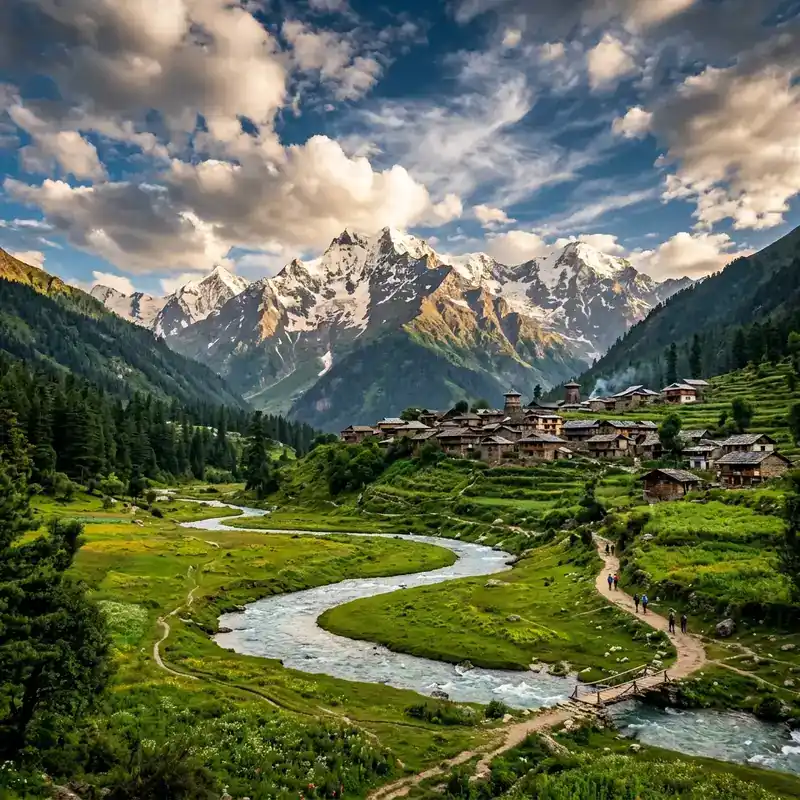
Har Ki Dun trek from Sankri through ancient villages, alpine meadows, and Swargarohini views. A 7-day guided Himalayan valley trek. Frequently listed among the Uttarakhand trekking guide.
Har Ki Dun Trek (3,566m) – The Valley of Gods is one of the most searched and recommended treks in Uttarakhand due to its unique landscape, accessibility, and the transformative experience it offers. This trek combines physical challenge with memorable views, making it a top choice for trekkers seeking both adventure and natural beauty in the Indian Himalayas.
Why Choose Har Ki Dun Trek
Har Ki Dun, widely referred to as the Valley of Gods, is a legendary 7-day trek starting from the basecamp village of Sankri in Uttarakhand. Set deep within the protected Govind Pashu Vihar National Park, the trail follows the magnificent Supin River all the way to a spectacular, cradle-shaped glacial valley sitting at 3,566 metres (11,700 ft). Unlike demanding summit expeditions like Kedarkantha or Pangarchulla, the Har Ki Dun trek is defined by its gradual, forgiving altitude profile and its immense cultural richness.
Over the course of 47 kilometres, trekkers weave in and out of dense forests of blue pine, silver birch, and Himalayan oak. The trail passes directly through isolated, historic mountain hamlets like Gangad, Puari, and the famous Osla village, where wooden houses with intricate carvings dangle off the sheer valley walls. The isolation of these villages means the culture is astonishingly preserved; traditional weaving, ancient farming practices, and unique local deities define everyday life here.
The trek culminates at the Har Ki Dun valley itself—a sprawling, intensely green meadow intersected by glacial streams, sitting directly beneath the monumental Swargarohini Massif. According to the Mahabharata, Swargarohini (literally "Stairway to Heaven") is the peak the Pandavas climbed to reach the afterlife. Sitting in the meadow, watching the sunset paint Swargarohini gold, it is impossible not to feel the deep, spiritual gravity of the landscape. Because of its manageable altitude and well-defined trail, Har Ki Dun is the absolute gold standard for families, beginners, and anyone looking for a long, deeply immersive Himalayan walk without extreme physical punishment.
Quick Facts
- Price: ₹10,500 - ₹12,500
- Duration: 7 Days / 6 Nights
- Difficulty: Moderate
- Max Altitude: 3,566 m (11,700 ft)
- Group Size: 10-15 Trekkers
How to Reach
- By Air: Jolly Grant Airport in Dehradun is the nearest airport, about 30 km from the city. Flights operate daily from Delhi.
- By Train: Dehradun Railway Station is well connected to Delhi by the Nanda Devi Express and Shatabdi Express.
- By Bus: AC Volvo buses operate overnight from ISBT Kashmiri Gate in Delhi to Dehradun ISBT (6-7 hours).
- Onward to Sankri: We organize shared transport pickups early in the morning from Dehradun directly to the Sankri basecamp (10 hours).
Permits & Safety
Permits: Har Ki Dun is deeply embedded within the Govind Pashu Vihar National Park. A forest department entry permit is strictly mandatory and is processed by our team at the Netwar check post before reaching Sankri. You must carry a valid, original Government Photo ID (Aadhaar Card, Passport, or Driving Licence) and a couple of photocopies. Foreign nationals must possess a valid Indian Visa and passport.
Roopkund Trek Cost
The typical cost for the Roopkund trek is ₹10,500 - ₹12,500. This includes most meals, camping, guides, permits, and support staff. See inclusions and exclusions below for details.
Best Time to Do This Trek
Why Har Ki Dun is the ultimate Himalayan Valley Trek
Unlike summit treks that focus on conquering a peak, Har Ki Dun is an immersion into a lost world. Nestled deep inside the Govind Pashu Vihar National Park, this cradle-shaped valley remains largely untouched by modernization. The trek follows the shimmering Supin River through vast, impossibly green pine forests, abruptly opening into sprawling alpine meadows that look like they belong in a fairytale.
But what truly sets Har Ki Dun apart is its culture. You will walk through ancient, wooden villages like Osla and Gangad, whose architecture and way of life have remained unchanged for centuries. The locals claim ancestry to the characters of the Mahabharata, and the imposing Swargarohini peak—visible from the valley—is famously believed to be the stairway to heaven used by the Pandavas. It’s a trek that serves equal parts natural grandeur and ancient mythology, making it profoundly moving for anyone who walks it.
Moments you won't forget
The Stairway to Heaven
Stare up at the breathtaking Swargarohini Massif. Legend says this exact peak was the path the Pandavas took to reach heaven after the Kurukshetra war.
Centuries-Old Villages
Walk through Osla and Gangad. The intricately carved wooden houses and the ancient Someshwar temple feel perfectly frozen in time.
A River Runs Through It
Hike for days alongside the roaring, aquamarine Supin River, crossing thrilling wooden bridges and resting on its mossy banks beneath towering pine forests.
Idyllic Meadow Camping
Camp at Kalkatiyadhar and Har Ki Dun. Wake up, unzip your tent, and find yourself looking down an endlessly green, pristine glacial valley.
- ✓Exploring the incredibly beautiful, U-shaped glacial valley of Har Ki Dun beneath the Swargarohini Massif.
- ✓Walking through dense, enchanting forests of blue pine, chestnut, and silver birch along the Supin River.
- ✓Experiencing the untouched, 3000-year-old culture and wooden architecture of Osla and Gangad villages.
- ✓Camping at breathtaking high-altitude meadows like Kalkatiyadhar and Boslo.
- ✓A highly gradual altitude gain makes it one of the safest multi-day treks in the Garhwal Himalayas.
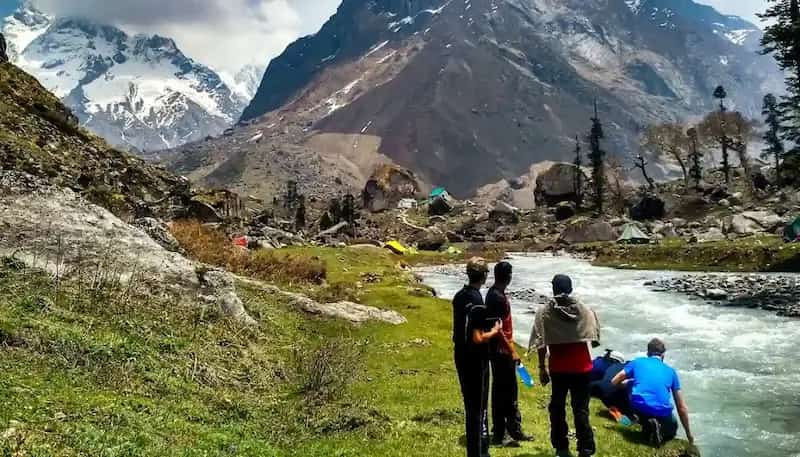
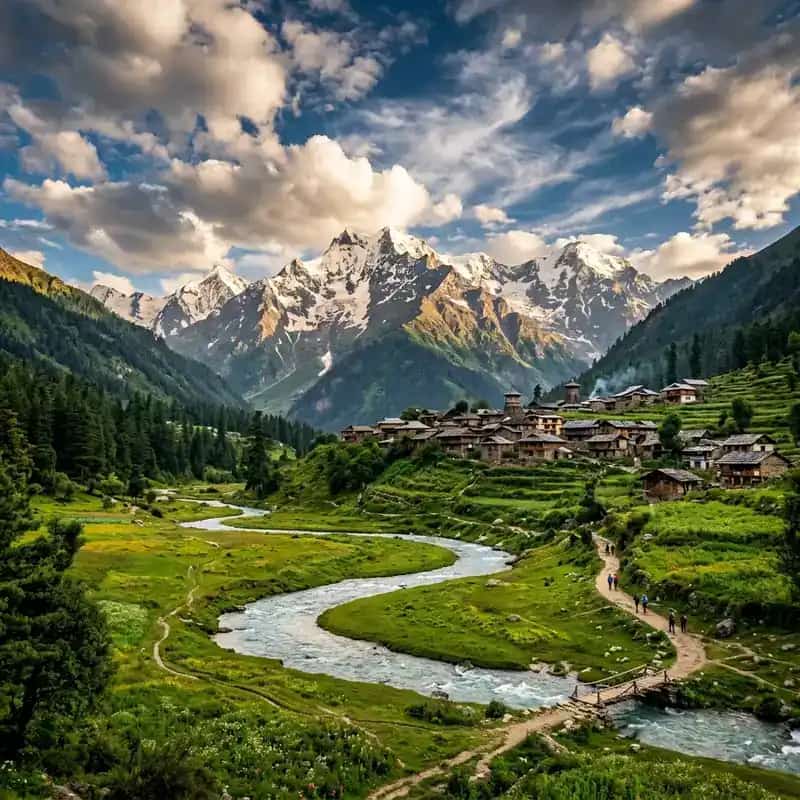
A visual walk-through of the trail
Route Overview
Day 1: Drive from Dehradun to Sankri (1,950 m) · 200 km · 8-10 Hours Drive Your journey begins at 6:00 AM from Dehradun. The drive to Sankri is famously beautiful, winding up alongside the Yamuna River and later the Tons River. You will pass through dense pine forests and the popular hill station of Mussoorie before diving into the remote Jaunsar-Bawar region. Sankri, sitting at 1,950 m, is the bustling basecamp for Har Ki Dun, Kedarkantha, and Bali Pass. You will check into a comfortable guest house, meet your trekking team, finalize any gear rentals like rain ponchos or trekking poles, and undergo a comprehensive safety briefing.

Day 2: Drive from Sankri to Taluka (12 km), Trek to Puani Garaat (2,500 m) · 10 km Trek · 6 Hours After an early breakfast, a thrilling 1-hour bumpy jeep ride on a dramatic cliffside road takes you to Taluka, the actual starting point of the trek. From Taluka, you descend to the banks of the Supin River and begin walking upstream. The trail here is lush, shaded by walnut and dense pine trees, with the river roaring fiercely to your left. You will cross several clear streams and wooden bridges. By late afternoon, you arrive at Puani Garaat, a sprawling clearing heavily shaded by the forest, where your first campsite is pitched right beside the mesmerizing river.

Day 3: Trek from Puani Garaat to Kalkatiyadhar (2,900 m) via Osla · 8 km · 5 Hours Today features the highlight of the lower trail: the village of Osla. The trail climbs steadily away from the river, entering steeply terraced farmland. Suddenly, Osla appears. Carved entirely out of wood and stone, the village is an architectural marvel. You will stop here to rest and explore the famous Someshwar Temple, known for its complex woodwork. Leaving Osla, the valley widens dramatically. The trail ascends toward Kalkatiyadhar, a vast, open meadow. Camping here is spectacular—the tree line drops below you, and the towering, snow-capped peaks of the Dhauladhar range reveal themselves entirely.

Day 4: Trek from Kalkatiyadhar to Har Ki Dun (3,566 m) and return to Boslo / Kalkatiyadhar · 10 km · 7 Hours Today is the day you enter the Valley of Gods. Leaving Kalkatiyadhar, the landscape transitions from forest to sprawling alpine meadows. You will navigate a few rocky moraines before the final ascent into the Har Ki Dun valley. As you crest the edge, the valley opens up like a massive green bowl, bisected by the Karmanasha stream. The Swargarohini Massif (I, II, and III) towers majestically at the far end, looking so close you could touch it. You will spend several hours exploring the valley floor, visiting the nearby Maninda Tal (a glacial lake), or simply lying in the grass absorbing the monumental scale. By mid-afternoon, you begin your descent back to your campsite at Boslo or Kalkatiyadhar.

Day 5: Trek from Kalkatiyadhar to Puani Garaat (2,500 m) · 8 km · 4 Hours The return journey is significantly faster as the gradient is almost entirely downhill. You will retrace your steps past the terraced fields of Osla. The descent is highly enjoyable; your body is now acclimatized, and the extra oxygen at lower altitudes makes the walking feel effortless. You will arrive back at Puani Garaat by early afternoon, allowing ample time to bathe in the freezing, refreshing river waters or simply relax under the shade of the giant walnut trees.

Day 6: Trek from Puani Garaat to Taluka, Drive to Sankri · 10 km Trek · 5 Hours + 1 Hour Drive Your final day of walking takes you back through the dense, shady forests alongside the Supin River. The trail undulates gently before the final approach into Taluka. Here, you will bid farewell to your mules and porters. Boarding the 4x4 jeeps, you'll endure the rugged 12 km drive back to Sankri. The evening is marked by a celebratory dinner, hot showers, and the triumphant feeling of having walked nearly 50 kilometres through the deep Himalayas.
Day 7: Drive from Sankri to Dehradun · 200 km · 9 Hours Drive You depart Sankri after breakfast, beginning the long, winding drive back to civilization. Stopping for lunch on the highway, you will arrive at the Dehradun Railway Station or ISBT by roughly 7:00 PM, concluding your journey. Do not book any flights or trains departing before 9:00 PM.
Upcoming Har Ki Dun Trek (3,566m) – The Valley of Gods Departures
See upcoming har ki dun trek (3,566m) – the valley of gods departures for all available dates.
| Date | Duration | Price | Seats | Action |
|---|---|---|---|---|
| 15 Mar 2026 | 4D/3N | ₹9,500 | 6 left | |
| 22 Mar 2026 | 4D/3N | ₹9,500 | 8 left | |
| 05 Apr 2026 | 4D/3N | ₹10,200 | 10 left |
Small group size (max 12 trekkers). Seats fill quickly during winter departures.
Overall: Moderate
Four independent axes. Use this to compare honestly against other Himalayan routes you've done.
- Physical Demandcardio + stamina
- Technical Skillrope / exposure
- Altitude ChallengeAMS risk
- Weather Exposurecold / wind / snow
Difficulty & Preparation
This trek is rated Moderate. Maximum elevation reaches 3,566 m (11,700 ft). Total route distance is approximately 47 km. The trek duration is 7 Days / 6 Nights from Dehradun.
Best seasons: April, May, June, September, October, November. Plan your trip around these months for the safest conditions and best visibility.
Reasonable fitness is required. Prior trekking experience is helpful but not mandatory if you prepare with regular cardio exercise in the weeks before departure.
Why Choose Us for Har Ki Dun Trek
- ✓Perfect for families and beginners
- ✓Beautiful valley views
- ✓Well-maintained trails
- ✓Safe and scenic route
Why trekkers trust us for Har Ki Dun Trek (3,566m) – The Valley of Gods
"The Har Ki Dun Trek (3,566m) – The Valley of Gods experience was flawless. From the quality of the microspikes provided to the deep knowledge of our guide, I never felt unsafe even when the snow was knee-deep. The food at 10,000 feet was unbelievably good!"
NIM-Certified Leaders
Every trek leader holds an Advanced Mountaineering qualification and Wilderness First Responder certification.
Satellite Connectivity
Connected via Garmin InReach/sat-phone beyond the tree line for immediate emergency response.
Oxygen & Oximeters
Mandatory twice-daily oxygen saturation checks. Emergency oxygen cylinders carried on every batch.
Ready for the mountains?
Limited upcoming batches available for the Har Ki Dun Trek (3,566m) – The Valley of Gods. Small groups of 12 max. Secure your spot before dates sell out.
Book Your Har Ki Dun Trek (3,566m) – The Valley of Gods NowFree cancellation up to 7 days before departure.
Moderate · April–November
Har Ki Dun vs Kedarkantha
Har Ki Dun offers more scenic valley views and is better for families, while Kedarkantha provides a summit experience with better winter snow conditions.
Best Time to Trek
The recommended months are April, May, June, September, October, November. These windows offer the most stable weather, safest trail conditions, and best mountain visibility.
Pre-monsoon (May–June): Clear skies, warming temperatures, and wildflower meadows at higher elevations. Snow may persist above 3,500 metres in early May, adding alpine character. This is typically the busiest trekking window.
Post-monsoon (September–October): After the monsoon rains withdraw, visibility sharpens dramatically. Autumn brings cooler temperatures, golden light, and far fewer trekkers on the trail. An excellent season for photography and solitude.
Spring (March–April): Retreating snow, blooming rhododendrons, and lengthening days. A transitional season with mild conditions at lower elevations and lingering snow higher up.
Month-by-Month Conditions
April: The snow has aggressively melted in the lower valleys, though thick patches remain around Har Ki Dun. The trail begins to bloom, but the real highlight is the relatively clear weather and crisp mountain air. Nights are cold (-2°C) but days are highly pleasant.
May: Considered the absolute peak month for Har Ki Dun. The entire valley erupts in vivid green. Wildflowers blanket the meadows of Kalkatiyadhar and Boslo. The daytime weather is highly agreeable (15°C) and river crossings are extremely manageable. Highly crowded but unbeatably beautiful.
June: Early summer. The vegetation is at its absolute thickest, reaching almost jungle-like density near Osla. The weather remains warm, but by the second week of June, the pre-monsoon showers begin. The river swells significantly, making the waterfalls along the route exceptionally dramatic.
September: Post-monsoon perfection. The valley is washed clean, leaving the foliage looking deeply, richly green. Trails can be slightly muddy in the first two weeks, but the clouds part to reveal absolutely staggering, crystal clear views of Swargarohini. The air is remarkably crisp.
October: The most photogenic month. The green meadows begin burning into sharp shades of yellow, gold, and brown. The skies are flawlessly blue, offering the sharpest visibility of the entire year. Temperatures begin to drop rapidly (0°C at night) as late autumn takes hold.
November: Early winter. The crowds vanish entirely, offering near-total solitude. The golden grasses turn brittle, and the first significant snows dust the upper peaks. Nighttime temperatures routinely drop to -5°C at higher camps. Ideal for trekkers who want the valley completely to themselves.
Safety & Precautions
Har Ki Dun is statistically one of the safest multi-day treks in the Indian Himalayas due to its incredibly gradual altitude profile. Gaining roughly 1,500 metres over three days allows your body ample time to acclimatize, drastically reducing the risk of Acute Mountain Sickness (AMS). However, we maintain strict adherence to high-altitude safety protocols. Our trek leaders, certified as Wilderness First Responders, check every trekker’s oxygen saturation and heart rate twice a day using pulse oximeters. Our med-kits are fully stocked with emergency oxygen, Nifedipine, and Dexamethasone. The primary trail risks involve unpredictable rain leading to slippery rocks, and navigating the wooden bridges over the roaring Supin River. During early spring or late autumn, temperatures at Har Ki Dun and Kalkatiyadhar drop below freezing (-5°C), requiring trekkers to carry high-quality thermal layering and -10°C rated sleeping bags, which are provided by our team.
Permits & Documentation
Har Ki Dun is deeply embedded within the Govind Pashu Vihar National Park. A forest department entry permit is strictly mandatory and is processed by our team at the Netwar check post before reaching Sankri. You must carry a valid, original Government Photo ID (Aadhaar Card, Passport, or Driving Licence) and a couple of photocopies. Foreign nationals must possess a valid Indian Visa and passport.
Who Should Reconsider
While beginner-friendly, the sheer distance of Har Ki Dun (nearly 47 km total walking) requires significant cardiovascular endurance. Individuals with chronic respiratory issues, severe knee/joint problems, or serious heart conditions should avoid this trek. The undulating terrain and long walking days (up to 14 km on Day 6) will severely punish weak knees. Trekkers should be capable of jogging 5 km in 35 minutes comfortably.
Getting There & Local Info
Sankri serves as the primary basecamp for Har Ki Dun. It is a well-established trekking hub where you can rent heavy down jackets, trekking shoes, poles, and waterproof gloves at reasonable daily rates. It is highly recommended to finalize your rentals on Day 1 evening. Crucially, there are no ATMs in Sankri. The last reliable cash point is in Purola, several hours prior. Withdraw enough cash in Dehradun to cover offloading fees, rentals, snacks, and driver tips. Network connectivity is extremely limited; BSNL and Jio work intermittently in Sankri, but absolutely all cellular networks vanish once you cross Taluka. Inform your family about your unreachability before leaving Sankri.
Included
- ✓Accommodation in standard homestays/guesthouses at Sankri and premium four-season tents during the trek.
- ✓All freshly prepared, highly nutritious vegetarian meals from dinner on Day 1 to Breakfast on Day 7.
- ✓Experienced, NIM-certified Trek Leader, local guides, and dedicated support and kitchen staff.
- ✓Comprehensive safety equipment including pulse oximeters, emergency oxygen cylinders, and high-altitude med-kits.
- ✓All forest permits, entry fees, and camping charges for Govind Pashu Vihar National Park.
Not Included
- —Transport from Dehradun to Sankri and back (arranged at an additional cost-sharing basis).
- —Offloading of personal rucksacks (available at an extra daily charge for mules/porters).
- —Personal trekking gear like down jackets, trekking shoes, or trekking poles (rentals available at Sankri).
- —Any meals taken during the road transit between Dehradun and Sankri.
- —Trek insurance and emergency medical evacuation costs.
Frequently Asked Questions
Is Har Ki Dun suitable for absolute beginners?
Yes, it is the most highly recommended trek for beginners. The altitude gain is so gradual that Acute Mountain Sickness (AMS) is extremely rare. However, the trek involves walking roughly 45 to 50 kilometres over 5 days. You must have the stamina to walk 10 kilometres a day on uneven forest trails.
What is the temperature like during the trek?
In May/June, daytime temperatures range from 15°C to 20°C, dropping to 0°C at night. In September/October, expect 12°C to 18°C during the day, with night temperatures plunging to -5°C. You will always need a heavy down jacket for the evenings.
Can I rent gear in Sankri?
Absolutely. Sankri has multiple gear rental shops where you can rent trekking shoes, heavy jackets, poles, and waterproof gloves. We can help you arrange these upon arrival on Day 1.
What if I cannot carry my heavy backpack?
You can offload your main rucksack onto our mules or porters for an extra daily charge. You must inform us at least 15 days in advance. You will carry a small 20L daypack with your water, fleece jacket, camera, and rain poncho.
Will there be snow on the Har Ki Dun trek?
Usually no, unless you trek very early in the season (March) or very late (late November). Har Ki Dun is known as a green valley trek, famous for its meadows and forests, not as a deep-winter snow trek like Kedarkantha.
Looking for a winter alternative from the same base? Consider the Kedarkantha Trek.
Explore more treks around Sankri or discover wellness retreats in Sankri.
Not sure which trek to choose?
Compare Kedarkantha vs Har Ki Dun →Trekking in Sankri
Sankri is one of the most popular trekking regions in Uttarakhand, offering world-class Himalayan experiences. The region provides diverse routes including Har Ki Dun Trek (3,566m) – The Valley of Gods and other renowned peak treks, snow treks, and valley expeditions. Whether you're a beginner or an experienced trekker, Sankri has routes suitable for all levels of experience and fitness.
Har Ki Dun Trek (3,566m) – The Valley of Gods — Complete Trek Guide
This comprehensive guide to Har Ki Dun Trek (3,566m) – The Valley of Gods covers everything you need to know: trek cost, detailed itinerary, difficulty assessment, best time to visit, complete packing list, and insider tips. Learn about the altitude profile, permits required, how to reach the trailhead, acclimatization strategies, and what to expect on the trail. Whether you're researching, planning, or preparing for Har Ki Dun Trek (3,566m) – The Valley of Gods, this guide provides all the essential information and local insights to help you prepare for a successful Himalayan trekking experience.
Explore All Treks in Sankri
Sankri offers diverse trekking experiences with multiple routes suiting all fitness levels. Discover other peaks, valley treks, and scenic routes in the Sankri region for your next Himalayan adventure.
View All Treks in Sankri →