Brahmatal vs Kuari Pass
Which Garhwal trek should you choose? The frozen lake winter trek from Lohajung, or the panoramic ridge walk from Joshimath? Both are moderate, both are accessible, but the experience is fundamentally different.
Brahmatal Trek — Winter snow trek from Lohajung. Frozen alpine lake, Trishul views.
Kuari Pass Trek — Lord Curzon Trail from Joshimath. Nanda Devi panorama across multiple days.
The Brahmatal Trek and the Kuari Pass Trek are the two premier moderate-difficulty treks in the Garhwal Himalaya region. Both stay below 4,000 metres, both are accessible to first-time high-altitude trekkers, and both deliver exceptional Himalayan scenery. Yet they are fundamentally different experiences — different seasons, different base towns, different signature landscapes.
This comparison breaks down the real differences to help you choose the right Garhwal trek for your experience level, preferred season, and the kind of mountain encounter you are looking for. Both routes feature in our best treks in Uttarakhand guide as top beginner-friendly options across the state.
Brahmatal vs Kuari Pass at a Glance
| Brahmatal | Kuari Pass | |
|---|---|---|
| Base Town | Lohajung (2,350 m) | Joshimath (1,875 m) |
| Max Altitude | 3,850 m | 3,876 m |
| Distance | 22 km | 30 km |
| Duration | 4 days | 5 days |
| Difficulty | Moderate | Moderate |
| Best Season | Dec–Mar (winter) | Mar–May, Oct–Nov |
| Signature | Frozen alpine lake | Continuous ridge panorama |
| Key Peaks | Trishul, Nanda Ghunti | Nanda Devi, Dronagiri, Chaukhamba |
The Experience: What Each Trek Feels Like
Brahmatal — The Frozen Lake Winter Trek
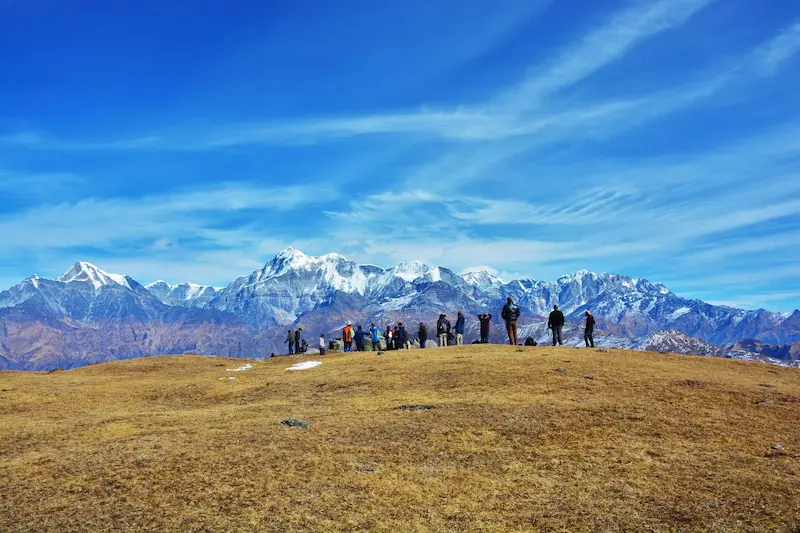
Brahmatal is a winter trek. You walk through snow-laden oak and rhododendron forest, camp on snow-covered clearings, and reach a frozen alpine lake at 3,850 metres. The landscape is white, silent, and dramatic. Night temperatures drop to −10°C at camp.
The signature moment is arriving at Brahmatal Lake — a frozen sheet of ice surrounded by snow ridges with the Trishul massif rising behind. It is a visual that exists only in winter.
Kuari Pass — The Panoramic Ridge Walk
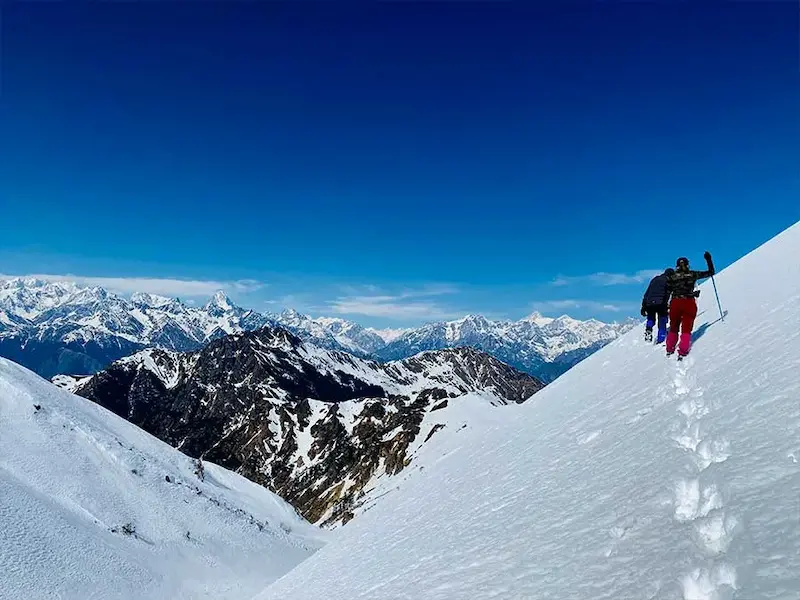
Kuari Pass is a ridge trek. Instead of walking toward a single destination, you walk along a high ridge with the Himalayan range arrayed before you for days. Nanda Devi (7,816 m), Dronagiri, Chaukhamba, Kamet — the entire Nanda Devi Sanctuary unfolds to your north.
In spring, rhododendrons bloom. In autumn, the forests turn gold and the peaks appear almost three-dimensional. The descent via Auli adds variety that Brahmatal's out-and-back structure does not offer.
When to Go: The Season Question
This is the most important differentiator. The two treks occupy almost entirely different seasonal windows:
This is exclusively a winter trek. The frozen lake and snow ridges that define the experience only exist in winter. Doing Brahmatal in summer misses the point entirely.
March to May (spring) and October to November (autumn) are the prime windows. Kuari Pass can be done in winter with snow gear, but it is fundamentally a spring/summer and autumn trek.
March is the only month where both are theoretically viable. Your travel dates will often make this decision for you. Planning December–February? Brahmatal. Planning April, May, October, or November? Kuari Pass.
Difficulty Comparison
Both treks are rated moderate, and on paper they look almost identical. But the effort profile differs:
Brahmatal — Shorter but Colder
Brahmatal is shorter (4 days, 22 km) but involves walking through snow for most of the route. Snow increases energy expenditure by 30–50% compared to dry trail. Combined with cold temperatures that drain stamina, Brahmatal feels harder than its distance suggests.
The cold is a genuine factor — if you are not comfortable in sustained sub-zero temperatures, Brahmatal will be more demanding psychologically.
Kuari Pass — Longer but Warmer
Kuari Pass is longer (5 days, 30 km) but on mostly dry trail with established camping infrastructure. The altitude gain is spread across more days, making the daily effort more manageable.
For first-timers, Kuari Pass is slightly more accessible due to the extra acclimatisation day and warmer conditions. If you have never slept in a tent at −8°C, Kuari Pass in spring is the gentler introduction.
Views & Scenery
Brahmatal — Concentrated Drama
Brahmatal delivers its visual payoff as concentrated moments — the frozen lake, the summit ridge, and the campsite panorama. The views of Trishul (7,120 m) and Nanda Ghunti (6,309 m) are striking, especially against winter's white foreground.
But much of the trail is in forest — you don't see mountains for extended stretches until you clear the treeline.
Kuari Pass — Sustained Panorama
Kuari Pass delivers views as a sustained experience. The ridge walk places you above the treeline for long sections, with the Nanda Devi range visible almost continuously from day two onward.
The scale is larger: Nanda Devi (7,816 m), Dronagiri (7,066 m), Chaukhamba (7,138 m), Kamet (7,756 m). In autumn, visibility can extend beyond 200 km.
Verdict: Kuari Pass for breadth and duration of mountain views. Brahmatal for the unique frozen lake visual and the drama of a snow-covered Himalayan landscape.
Getting There & Logistics
Brahmatal from Lohajung
10 hours from Rishikesh by road via Karnaprayag and Dewal. Lohajung is a small village with basic guesthouses and no ATMs. The road quality is acceptable but narrow in the final stretch. Less frequent bus services.
Total trip: 7–8 days from Delhi (2 travel days each way + 4 trek days).
Kuari Pass from Joshimath
9–10 hours from Rishikesh via the Badrinath highway. Joshimath is a proper town with hotels, restaurants, ATMs, and shops. Better road infrastructure, more frequent buses, and more accommodation options.
Total trip: 8–9 days from Delhi (2 travel days each way + 5 trek days).
Who Should Choose Which
Choose Brahmatal if:
- You want a winter snow trek (December–March)
- You are drawn to the frozen lake experience
- You are comfortable with cold-weather camping (−8 to −10°C)
- You have 4 trek days available
- You want an alternative to the crowded Kedarkantha circuit
Choose Kuari Pass if:
- You want the widest possible Himalayan panorama
- You prefer spring or autumn trekking (milder weather)
- This is your first high-altitude Himalayan trek
- You value historic trails (Lord Curzon Trail)
- You want the option to extend to Pangarchulla summit
Next Steps After Each Trek
After Brahmatal
The natural progression is the Roopkund Trek — same base village (Lohajung), significantly higher altitude (4,800 m), and challenging difficulty. Brahmatal at 3,850 m gives you the altitude confidence to tackle Roopkund.
After Kuari Pass
The natural extension is Pangarchulla Peak — the route shares the same approach trail before diverging for a summit push to 4,590 m. Some itineraries combine both, crossing Kuari Pass on day 3 and pushing to Pangarchulla from Khullara camp.
Brahmatal — The Ideal First Snow Trek
Frozen lake, snow-covered ridges, and Himalayan views. 4 days, moderate difficulty, no technical sections.
Frequently asked questions
Which is easier — Brahmatal or Kuari Pass?
Both are rated moderate difficulty. Brahmatal reaches 3,850 m over 4 days (22 km), while Kuari Pass reaches 3,876 m over 5 days (30 km). The altitude and difficulty are nearly identical. The main difference is duration — Kuari Pass covers more ground over an extra day, spreading the effort more evenly. Neither requires technical skills.
Can I do Brahmatal and Kuari Pass in one trip?
Not easily. Brahmatal is a winter trek (December–March) from Lohajung, while Kuari Pass is best in spring (March–May) or autumn (October–November) from Joshimath. The only overlap is March, when both are theoretically possible but the logistics (different base towns, 6+ hours apart by road) make back-to-back trips impractical. Most trekkers do them in separate trips.
Which trek has better views?
Kuari Pass is widely considered the better panoramic trek — the ridge walk offers near-continuous views of Nanda Devi, Dronagiri, Chaukhamba, and Kamet across multiple days. Brahmatal's views are concentrated around the summit ridge and lake campsite, with Trishul and Nanda Ghunti as the signature peaks. Kuari Pass wins on breadth of views; Brahmatal wins on the unique frozen lake experience.
Which is better for a first Garhwal trek?
Either works well as a first Garhwal experience. If you want a winter snow trek and enjoy camping by a frozen lake, choose Brahmatal. If you want the widest possible Himalayan panorama in comfortable spring or autumn weather, choose Kuari Pass. Both are well-supported by guided operators and suitable for first-time high-altitude trekkers with basic fitness.
How do I reach the starting points?
Brahmatal starts from Lohajung (10 hours from Rishikesh via Karnaprayag). Kuari Pass starts from Joshimath (9–10 hours from Rishikesh via Rudraprayag). Both are accessed by road from Rishikesh or Haridwar. Joshimath has better road infrastructure and more frequent bus services due to its position on the Badrinath pilgrim route.