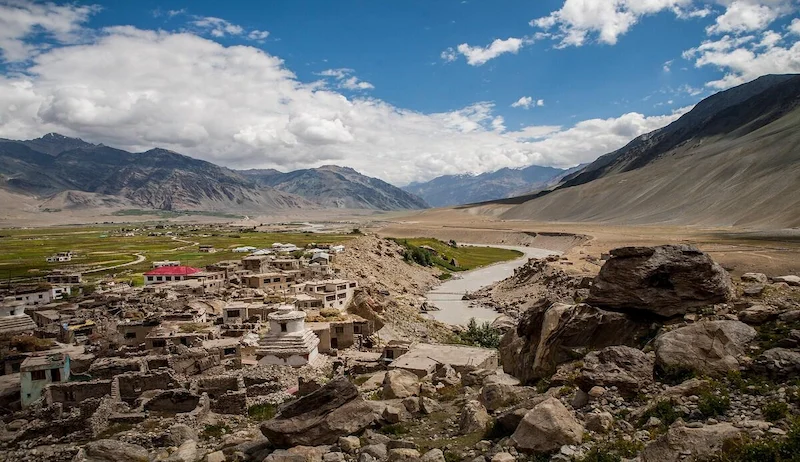
Zanskar
A high-altitude river valley in Ladakh — raw remoteness, ancient monasteries, and transformative silence.
“Zanskar is not chosen lightly. It is chosen because nowhere else on the subcontinent offers this particular combination — a high-altitude river valley sealed by mountains, monasteries older than most nations, and a silence so deep it becomes audible. At 3,500 meters in Ladakh, the air is thin, the sky is impossibly close, and the land demands that you arrive fully. Nothing here is convenient, and that is the point.”
Why Stillness & Movement Thrive in Zanskar
Zanskar holds two registers simultaneously. The monasteries — Phugtal, Karsha, Stongde — carry centuries of meditative stillness. The river gorges, high passes, and wind-carved valleys demand physical presence and movement. You can sit in a 900-year-old gompa and feel the accumulated silence. Or you can traverse the Zanskar Gorge in winter, walking on frozen rivers where the body becomes the meditation. The valley holds both.
Why Inner Work Succeeds in Zanskar
Altitude & Awareness
At 3,500 meters, the reduced oxygen naturally slows thought and heightens sensory presence. The body recalibrates. Breathing becomes conscious. This is not discomfort — it is precision. The altitude does half the work of meditation.
Extreme Remoteness
Zanskar is 230 km from Leh, through mountain passes that close for half the year. This is genuine separation from the world. No casual visitors. No tourist noise. When you arrive, you have truly left everything behind.
Monastic Lineage
The valley has been a centre of Buddhist contemplative practice for over a thousand years. Phugtal Monastery clings to a cliff face above a cave. Karsha sits above the valley floor like a sentinel. The land carries the weight of accumulated practice — you feel it without needing to believe anything.
Geological Silence
The rock formations here are 500 million years old. The river has carved its gorge over millennia. This is not picturesque scenery — it is deep time made visible. Walking through it recalibrates your sense of scale and urgency.
Places & Sights
Phugtal Monastery
A monastery built into a cliff face above a natural cave, accessible only on foot. Founded in the 12th century, it remains a functioning Buddhist community. The approach — through a narrow gorge, then up a steep trail — is itself a pilgrimage. When you arrive, the combination of architecture, silence, and altitude creates something that photographs cannot capture.
Best time: June–October
Karsha Monastery
The largest monastery in Zanskar, sitting above the Padum valley like a citadel. Home to the annual Gustor festival, where masked dances enact Buddhist teachings. The monastery overlooks barley fields and the river below — a place where the sacred and agricultural coexist without friction.
Best time: Year-round
Zanskar River Gorge
The river has carved a canyon through ancient rock over millions of years. In summer, it runs turquoise. In winter, it freezes into the Chadar — a walkable ice highway. The gorge is the geological spine of the valley, and walking through it places you inside deep time.
Best time: Year-round (frozen January–February)
Pensi La
The 4,400-meter pass that separates Zanskar from the rest of Ladakh. Crossing it is not a scenic detour — it is the threshold. The view of Drang-Drung Glacier from the pass is stark and massive. In autumn, the pass closes with snow, sealing the valley for winter.
Best time: June–November
Stongde Monastery
A smaller, quieter gompa perched on a ridge above the Stongde village. Less visited than Karsha, it offers an intimacy that larger monasteries cannot. The monks here live simply, and visitors are welcomed into the rhythm rather than observed from outside.
Best time: June–October
Padum
The administrative centre of Zanskar — a small town that serves as the valley's hub. Not picturesque in the conventional sense, but functional and honest. This is where you resupply, rest, and begin to understand the pace of life in a place that is cut off for half the year.
Best time: Year-round
Soft Experiences
Monastery Sitting
Spend time in a gompa — not as a tourist, but as someone sitting still. Watch the light move across the prayer hall. Hear the chanting from another room. Feel the cold stone beneath you. This is not guided meditation. This is being present in a place where presence has been cultivated for centuries.
River Walking
Follow the Zanskar River on foot — not on a trail, but along the riverbank. The sound of water, the shifting colours of rock, the way the valley opens and closes around you. Walking without destination, letting the river set the pace.
Village Encounters
Zanskar villages live by seasons, not clocks. Barley harvest, butter tea preparation, yak herding. Walking through a village means witnessing a way of life that has persisted for centuries — not as performance, but as daily rhythm.
High Pass Dawn
Crossing a high pass at dawn — when the air is coldest and clearest — is a Zanskar signature experience. The world below is still in shadow while you stand in sunlight at 4,000 meters. The body is working; the mind is empty. This is integration without trying.
Why People Come to Zanskar
People typically seek Zanskar for:
Radical Disconnection
For those who need more than a weekend away. Zanskar offers separation so complete that the nervous system has no choice but to reset. No phone signal for stretches. No ambient distraction. Just you, the valley, and time.
Contemplative Depth
If your practice has plateaued in comfortable settings, Zanskar strips away what is unnecessary. The altitude, silence, and monastic energy create conditions where meditation deepens naturally.
Physical & Spiritual Integration
For those who do not separate body and spirit. Trekking through gorges, sitting in gompas, walking with yak herders — Zanskar makes movement and stillness the same practice.
Encounter with Deep Time
Not everyone needs healing. Some need perspective. The geological scale of Zanskar — visible in every cliff face, river bend, and fossil — teaches proportion. Your problems become appropriately sized.
The Geography of Zanskar Valley
Zanskar is a high-altitude river valley in the Ladakh region of northern India, formed by the convergence of the Stod and Lungnak rivers into the Zanskar River. The valley sits between the Great Himalayan Range and the Zanskar Range, at an average elevation of 3,500 metres — higher than any point in the European Alps.
The geological story here is written in rock. The valley floor is ancient seabed, uplifted over millions of years. Fossils of marine organisms appear in cliff faces at 4,000 metres. The Zanskar River has carved a gorge through these layers, creating a visual timeline of deep geological history that is visible from any point in the valley.
The valley is roughly 300 kilometres long and accessible by road only from June to November, when the Pensi La pass (4,400 metres) is open. In winter, the only traditional route is the Chadar — the frozen surface of the Zanskar River itself. This seasonal isolation is not a logistical inconvenience; it is the defining feature of the valley. It has preserved a way of life, a spiritual tradition, and an environmental quality that more accessible Himalayan regions have lost.
The landscape is austere rather than lush. Bare rock, sparse vegetation, turquoise river water against brown and grey stone. The beauty is mineral, structural, elemental. For meditation practitioners, this austerity is an asset — there is nothing decorative to distract the eye. The land teaches simplicity by being simple.
Buddhist Monasteries and Spiritual Traditions of Zanskar
Zanskar has been a centre of Tibetan Buddhist practice for over a thousand years. The valley's monasteries — Phugtal, Karsha, Stongde, Sani, Bardan — are not museums or tourist attractions. They are functioning contemplative communities where monks maintain daily rituals of meditation, chanting, and study that have continued without interruption for centuries.
Phugtal Monastery is perhaps the most remarkable. Built into a cliff face above a natural cave at the head of a narrow gorge, it is accessible only by a footpath. The approach itself is a pilgrimage — two hours of walking through increasingly dramatic terrain before the monastery appears, improbably clinging to the rock. Inside, the prayer hall carries the accumulated stillness of nine hundred years of practice.
Karsha Monastery, the largest in the valley, sits above Padum like a citadel. It hosts the annual Gustor festival, where monks perform masked dances (cham) that enact Buddhist teachings about impermanence and liberation. The festival is not performance — it is liturgy, and witnessing it places you inside a living tradition rather than outside it.
Stongde Monastery is smaller and less visited. Perched on a ridge above its village, it offers an intimacy that larger gompas cannot. Visitors here are welcomed into the rhythm of monastic life — morning prayers, butter tea, the sound of horns echoing across the valley — rather than observed from a tourist viewpoint.
For retreat participants, these monasteries offer something no purpose-built meditation centre can replicate: the weight of accumulated practice. Sitting in a gompa where thousands of practitioners have sat before you creates a quality of silence that is qualitatively different from silence in a new building. The stones have been saturated with attention.
Why Isolation Deepens Meditation Practice
The neuroscience of meditation retreat environments is increasingly clear: sensory reduction accelerates the transition from default-mode network activity (mind-wandering, self-referential thought) to states of focused attention and present-moment awareness. Zanskar provides this sensory reduction at a scale that no urban or coastal retreat centre can match.
At 3,500 metres, the partial pressure of oxygen is approximately 65% of sea-level values. This subtle hypoxia has measurable effects on cognition: the thinking mind slows, rumination decreases, and sensory perception sharpens. Experienced meditators report that sessions at altitude feel qualitatively different — less effortful, more spacious, with fewer intrusive thoughts.
The absence of phone signal, internet, ambient traffic noise, and commercial activity removes the environmental triggers that keep the nervous system in a state of low-grade vigilance. In Zanskar, there is nothing to check, nothing to respond to, nothing to consume. The nervous system, deprived of its habitual stimulation, begins to downregulate within 48 to 72 hours.
The physical effort required to reach Zanskar — the long drive, the high pass, the adjustment to altitude — also serves a psychological function. It creates a felt sense of threshold-crossing that more accessible locations cannot provide. When you arrive in Zanskar, your body knows you have truly left your ordinary life behind. This somatic knowing supports the psychological letting-go that meditation requires.
Finally, the geological scale of the landscape provides a form of perspective therapy. The cliffs, the river gorge, the fossil-bearing rock — these are reminders of timeframes in which individual human concerns are appropriately small. This is not nihilism; it is proportion. And proportion is one of the most reliable outcomes of deep meditation practice.
Best Months for a Zanskar Retreat
Zanskar's accessibility and character change dramatically with the seasons, and choosing the right month is as important as choosing the right retreat format.
June is the earliest reliable window. The Pensi La pass opens (weather permitting) and the valley awakens from winter isolation. Rivers are swelling with snowmelt, the air is cool and clear, and the monasteries prepare for summer. June offers the freshness of a place emerging from months of silence. It is ideal for practitioners who want to arrive when the valley's energy is expansive and new.
July and August are peak season — the warmest months, the best trekking conditions, and the greatest accessibility. Barley fields ripen. The sky reaches its deepest blue. Monastic festivals occur during this period. For first-time visitors to Zanskar, July or August provides the most comfortable conditions and the fullest expression of the valley's life.
September is the sweet spot for experienced practitioners seeking depth. The tourist trickle diminishes. The light turns golden. Nights grow cold. The valley begins its inward turn toward winter. There is a quality of impermanence in September Zanskar — the knowledge that the pass will close soon, that the valley is preparing to seal itself — that deepens any contemplative practice.
January and February are for the Chadar experience only. The Zanskar River freezes into a walkable sheet of ice, and the traditional winter route opens. Temperatures drop to minus 25–30°C. This is not a retreat in the conventional sense — it is an extreme physical and psychological experience that strips away everything inessential. We offer guided Chadar programmes for those who are physically prepared and psychologically ready for radical conditions.
We do not operate in October through December or March through May. The pass is unreliable, weather conditions are transitional, and the risk-to-benefit ratio does not support responsible retreat programming.
Preparing for a High-Altitude Retreat in Zanskar
A Zanskar retreat requires more preparation than a lowland meditation programme. The altitude, remoteness, and basic infrastructure demand physical readiness alongside contemplative intention.
Physical fitness: You do not need to be an athlete, but you should be comfortable walking 5–8 kilometres on uneven terrain at altitude. Basic cardiovascular fitness — the ability to climb stairs without breathlessness, or walk briskly for 30 minutes — is the minimum. If you cannot manage this at sea level, Zanskar will be unnecessarily difficult.
Altitude acclimatisation: We build acclimatisation into every Zanskar programme. Participants fly to Leh (3,500 metres) and spend two days acclimatising before the drive to Zanskar. During this period, we recommend walking gently, staying hydrated, and avoiding alcohol. Most altitude discomfort resolves within 48 hours. If you have a history of severe altitude sickness, consult your physician before booking.
Meditation experience: We recommend at least some prior meditation experience for Zanskar retreats — even if it is only a few months of home practice or a single weekend retreat elsewhere. The altitude and isolation amplify everything, including emotional intensity. Having a basic framework for working with difficult mind-states helps you meet these conditions constructively rather than being overwhelmed by them.
What to bring: Warm layers (temperatures vary from 25°C in daytime sun to 0°C at night in summer), a headlamp, personal medications, and sun protection. We provide detailed packing lists upon booking. Accommodation is basic but adequate — guesthouses and camp-style lodging with meals provided.
What to leave behind: Expectations of comfort, tight schedules, and the need for constant connectivity. Zanskar works best when you arrive with openness rather than a checklist. The valley will teach you what it wants to teach you — your job is to be available for it.
Zanskar vs. Other Himalayan Retreat Locations
Understanding where Zanskar sits relative to other Himalayan retreat options helps you assess whether it is the right choice for your current stage of practice.
Zanskar vs. Rishikesh: Rishikesh offers spiritual lineage, ashram infrastructure, experienced teachers, and the energy of the Ganges at 372 metres. It is accessible, warm, and embedded in a living yogic tradition. Zanskar offers radical isolation, monastery silence, and altitude-driven contemplative depth at 3,500 metres. Choose Rishikesh for tradition and teacher guidance. Choose Zanskar for environmental immersion and self-reliant practice.
Zanskar vs. Chakrata: Chakrata is our most accessible deep-silence location — dense forest at 2,000 metres, two hours from Dehradun. It provides genuine silence without extreme conditions. Zanskar is for those who have experienced what Chakrata offers and want to go further. Many of our long-term participants follow a progression: Chakrata first, then a longer programme in Zanskar.
Zanskar vs. Munsiyari: Munsiyari offers alpine spaciousness facing the Panchachuli peaks at 2,200 metres — open sky, vast views, and contemplative stillness. Zanskar replaces spaciousness with intensity — closer walls, deeper gorges, older stone, more extreme conditions. Munsiyari is expansive; Zanskar is concentrating.
Zanskar vs. international destinations (Bali, Thailand, Nepal): Southeast Asian retreat centres typically offer tropical comfort, professional facilitation, and modern amenities. They are excellent for structured programmes and teacher-led intensives. Zanskar offers none of these comforts and all of the depth that comfort prevents. If you have done tropical retreats and found them pleasant but not transformative, Zanskar is the next threshold.
The right choice depends on your experience level, physical readiness, and what you are seeking. If you are uncertain, our mountain planners can help you assess — reach out through any enquiry form on this site.
Retreats in Zanskar
Meditation & Silence
Drop into the depth that silence reveals, with guidance and sanctuary.
Explore Journey →Burnout Recovery Retreat in the Himalayas
A weekend mountain retreat designed to help you disconnect from constant work pressure and reconnect with nature, slow living, and meaningful rest.
Explore Journey →Yoga Retreats & Movement
Personal-practice Yoga retreats with asana, pranayama, and meditation; current dates and programme details are confirmed by enquiry.
Explore Journey →Creative Healing Retreat
A guided creative retreat combining art, reflection, gentle yoga, and time in Himalayan nature.
Explore Journey →Essential Information
Best Seasons
June–September (summer trekking and retreats). January–February (Chadar season for the committed).
Accessibility
Fly to Leh (Kushok Bakula Rimpochee Airport), then 230 km by road (~8–10 hours) via Pensi La pass. Road open June–November only. Winter access via Chadar (frozen river) or helicopter.
Crowd Profile
Very sparse. Even in peak season, Zanskar sees a fraction of the visitors Ladakh receives. In shoulder and winter months, you may be the only outsider in the valley.
Not For
If you need comfort, warmth, or easy access — Zanskar is not the place. Accommodation is basic (guesthouses and camping). Altitude requires acclimatisation. If you are not prepared for physical challenge alongside inner work, choose a gentler location.
Timing & the Valley Rhythm
June – July — Awakening
The passes open. The valley comes alive after months of winter isolation. Rivers swell with snowmelt. Monasteries prepare for summer festivals. The energy is expansive — good for those seeking openness and new perspective.
August – September — Fullness
Peak summer. The valley is at its most accessible and alive. Barley fields ripen. The sky is deepest blue. Trekking conditions are optimal. This is when Zanskar reveals its full scale — vast, luminous, unforgettable.
October – November — Withdrawal
The valley empties. Passes begin to close. Local communities prepare for winter. The mood shifts inward. For those comfortable with solitude and cold, this is when Zanskar becomes most itself — quiet, spare, essential.
January – February — Chadar — Frozen River
The Zanskar River freezes into a walkable ice sheet — the famous Chadar Trek. Temperatures drop to -30°C. This is extreme, transformative, and only for those prepared. Walking on frozen rivers in a sealed valley is an experience that marks people permanently.
Zanskar is the most remote location in our network — chosen for people who have outgrown accessible retreat settings and need the land itself to challenge and hold them. If Zanskar feels too extreme, Chakrata offers forest silence at a gentler altitude; Sankri provides high-altitude trekking with more infrastructure. Each location serves a different threshold of readiness.
If this description pulls at something real in you — if you recognise the need for genuine remoteness, for a place where the land itself becomes the teacher — reach out. We will help you understand whether Zanskar is the right next step for your journey.