Rishikesh
Yoga capital and spiritual gateway—traditions alive on the Ganges.
“Rishikesh is chosen for its spiritual gravity. On the banks of the Ganges, in the yoga capital of India, this is where thousands of years of contemplative traditions are still alive in daily practice. This is not a place dressed up as spiritual — it is a place where spiritual life is lived. The river itself teaches. The ashrams around you remind you that you are part of something much older than yourself.”
Why Spiritual Practice Works in Rishikesh
Rishikesh holds yoga in all its forms — seated meditation and dynamic asana, philosophy and breathing practice, stillness and movement. The spiritual traditions here do not separate inner work from embodied practice. A retreat can lean toward devotional or philosophical depth. Or it can emphasize yoga and movement within the spiritual container. The river facilitates everything.
Why Deep Practice Happens in Rishikesh
Unbroken Spiritual Tradition
Rishikesh has been the center of Hindu philosophy, yoga, and meditation for millennia. This is not tourism — it is archaeology of living practice. The energy is real and sustained.
The Ganges as Teacher
The presence of the river is constant — in rituals, in bathing, in evening aarti ceremonies that fill the air. The Ganges is not metaphor here — it is presence.
Accessible Spirituality
Unlike remote mountain ashrams, Rishikesh offers spiritual immersion without deprivation. You can live simply while having comfort. You can study deeply while staying fed and warm.
Pluralism Without Syncretism
Rishikesh is home to thousands of ashrams teaching different paths — Advaita, Bhakti, Yoga, Tantra. You choose your tradition without being sold one unified fantasy.
Places & Sights
Beatles Ashram Visual Journaling
The existing Beatles Ashram combines forest-reclaimed structures, meditation cells, and murals. Its layered visual environment can be used for quiet observation, sketching, and creative journaling during an art retreat.
Best time: Year-round
Triveni Ghat
The primary bathing ghat where three rivers are said to converge. Every evening, the Ganga Aarti ceremony fills the air with fire, chanting, and devotion. Thousands gather. The ritual is unchanged across centuries. Sitting at Triveni Ghat at dusk is encountering a practice older than any wellness trend — and understanding why it endures.
Best time: Year-round
Ram Jhula & Lakshman Jhula
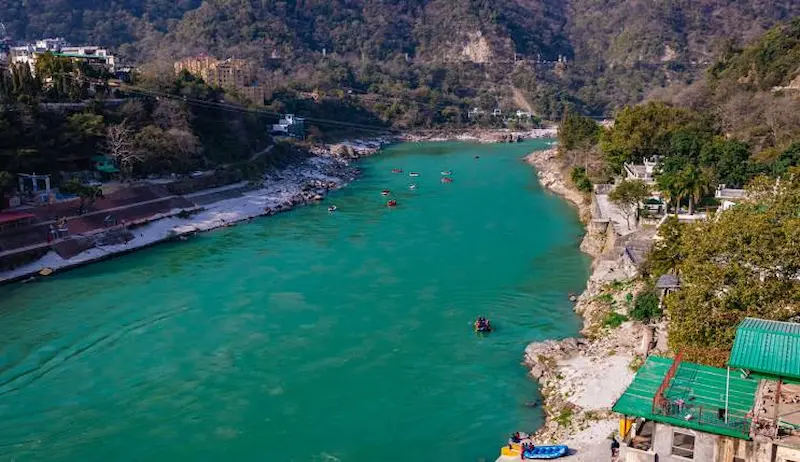
Iron suspension bridges spanning the Ganges, connecting ashrams on both banks. Walking across, you see the river below — green in winter, swollen and brown in monsoon. The bridges are functional, not scenic — locals, sadhus, and seekers cross daily. Standing mid-bridge, you are literally suspended between two banks of spiritual practice.
Best time: Year-round
The Beatles Ashram (Chaurasi Kutia)
The former Maharishi Mahesh Yogi ashram, now a ruin reclaimed by forest. Meditation cells are covered in murals. Trees grow through rooftops. The place holds a strange energy — the residue of 1960s spiritual tourism meeting genuine contemplative tradition. Walking through it is walking through layers of intention, some sincere, some naive.
Best time: Year-round
Neelkanth Mahadev Temple
A Shiva temple at 1,330 metres in the hills above Rishikesh, reached by a forest trail or winding road. The temple marks the spot where Shiva is said to have consumed the cosmic poison. The trek to reach it passes through sal forest and offers views of the Ganges valley below. Pilgrimage here is physical — the climb is the offering.
Best time: Year-round (avoid monsoon)
Rajaji National Park
A 820-square-kilometre sanctuary of Shivalik hills, sal forest, and river systems bordering Rishikesh. Home to Asian elephant, tiger, leopard, and king cobra. The park is the wild counterpoint to the spiritual town — raw nature meeting lived tradition. Early morning safaris encounter wildlife moving through mist in terrain unchanged since the Vedic period.
Best time: November–June
Ganges Confluence at Devprayag
An hour upstream from Rishikesh, the Alaknanda and Bhagirathi rivers merge to form the Ganges. The two different-coloured waters — one blue-green, one grey — run side by side before blending. This meeting of waters has been sacred for millennia. Watching the confluence teaches something about merging that words cannot express.
Best time: Year-round (clearest October–March)
Soft Experiences
Ganga Riverbank Art Observation
Quiet observation along the existing Ganges riverbank, using changing light, moving water, river stones, and the surrounding landscape as subjects for sketching, painting, or visual journaling.
Evening Aarti Witness
Attending the evening Ganga Aarti at Triveni Ghat or Parmarth Niketan — not as a tourist, but as a participant. Holding a small oil lamp. Joining the chanting. Feeling the collective devotion of hundreds of people facing the river. The ceremony lasts 45 minutes. Its effect lasts much longer. This is not spectacle — it is practice.
Pre-Dawn River Walking
Walking along the sandy Ganges bank before sunrise, when the town is silent and the river is loudest. Sadhus sit in meditation on rocks. The water catches first light before the buildings do. The air is cold and clean. This is Rishikesh before it puts on its public face — and it is a different, more honest place.
Ashram Morning Practice
Joining a public morning practice at any of the open ashrams — Sivananda, Parmarth, Ved Niketan. The practice might be chanting, pranayama, or silent meditation. You sit among strangers who share nothing except the intention to be present. The communal container is the teacher. Nobody asks why you are there.
River Sitting Practice
Finding a large boulder mid-river (accessible in winter when water levels drop) and sitting on it for an extended period. The Ganges moves on all sides. Sound wraps around you. The sensation of being surrounded by moving water while sitting still creates a natural form of sensory meditation that requires no instruction.
Temple Trail Walking
Walking the network of lanes that connect small temples, shrines, and meditation caves above the main ghats. Many are unmarked. Some are attended by a single devotee. Others are empty. The walking itself becomes a form of darshan — encountering sacred space not as destination but as texture woven through everyday geography.
Beyond the Retreat
Kunjapuri Sunrise Hike
2–3 hours round tripA short climb to the Kunjapuri Devi temple at 1,676 metres above Rishikesh. The trail is gentle — stone steps through forest, then open ridge. At dawn, the entire Himalayan range reveals itself: Bandarpunch, Swargarohini, Chaukhamba, the Gangotri group. Below, the Ganges curves through the valley like a silver thread. This is not a trek — it is a pilgrimage to perspective. The temple itself is modest. The view is not.
Best time: Year-round (start pre-dawn for sunrise)
Neer Garh Waterfall Walk
1–2 hoursA forest path from Rishikesh leads to a series of cascading falls hidden in the Shivalik foothills. The trail passes through deciduous forest and crosses small streams. The waterfall drops in two stages into natural rock pools. After monsoon, the volume is dramatic. In winter, the water is cold and clear, the forest quiet. This is the kind of walk where you go to hear water and forget you were in a town twenty minutes ago.
Best time: October–May (avoid heavy monsoon)
Ganga Riverbank Walking
1–3 hours (choose your stretch)Between Ram Jhula and Lakshman Jhula, the eastern bank of the Ganges opens into sandy stretches, boulder fields, and quiet beaches accessible only on foot. The walking is unstructured — you follow the water. In winter, when levels drop, mid-river boulders become sitting places. In morning light, the Ganges is turquoise and fast. The walk has no destination. The river is the destination. Sadhus, local fishermen, and the occasional wild elephant from Rajaji share the bank.
Best time: October–March (lower water levels)
Riverbank Meditation Spots
Open-endedRishikesh offers something no mountain location can: sitting practice beside moving water with thousands of years of contemplative intention embedded in the geography. Specific spots along the eastern bank — below Parmarth Niketan, near the old ferry crossing, at the confluence beach south of Ram Jhula — offer natural sitting places where the sound of the Ganges creates a continuous ambient field. No instruction needed. No tradition required. The river holds the container. You bring the attention.
Best time: Year-round (early morning or late afternoon)
Why People Come to Rishikesh
People typically seek Rishikesh for:
Spiritual Grounding & Philosophy
For those seeking direct connection to yoga and meditation lineages. Rishikesh is where these practices originate — not where they are repackaged.
Devotional Practice & Belonging
When the path is bhakti (devotion). The temples, ceremonies, and chanting practices create collective energy that supports devotional work.
Teacher-Led Deep Study
Rishikesh attracts serious teachers of Vedanta, yoga philosophy, and meditation. If your retreat requires study of texts and lineage, this is the place.
Ritual & Sangha Immersion
For people seeking to practice alongside other seekers in real ashram life. Morning practices, communal meals, evening ceremonies — the structure itself is transformative.
Retreats in Rishikesh
Sound Healing
Bathe your nervous system in resonance that restores and recalibrates.
Explore Journey →Yoga Retreats & Movement
Personal-practice Yoga retreats with asana, pranayama, and meditation; current dates and programme details are confirmed by enquiry.
Explore Journey →Meditation & Silence
Drop into the depth that silence reveals, with guidance and sanctuary.
Explore Journey →Creative Healing Retreat
A guided creative retreat combining art, reflection, gentle yoga, and time in Himalayan nature.
Explore Journey →Private & Custom
A retreat designed entirely around your needs, timeline, and intentions.
Explore Journey →Essential Information
Best Seasons
March–May and September–November. December–February has high tourist traffic and festivals (energizing but crowded).
Accessibility
Closest to Delhi and major cities (3 hours). Full infrastructure, restaurants, urban amenities. River-based geography but still accessible by road.
Crowd Profile
Rishikesh is a pilgrimage center and yoga tourism hub. This means energy is high, community is real, but it is never truly secluded. “Quiet” is relative here.
Not For
If you seek mountain isolation, wilderness, or escape from human presence — Rishikesh is not suitable. If you prefer secular retreat without spiritual context, choose other locations.
Timing & the Spiritual Calendar
October – November — Clarity
Post-monsoon weather is clear and cool. Major festivals (Dussehra, Diwali) bring energy and rituals. Good for people seeking festive spirituality and celebration.
December – February — Peak Pilgrimage
Winter attracts pilgrims and seekers from across India and the world. Aarti ceremonies are full. The spiritual calendar is dense. Energy is high.
March – May — Practice
Heat increases but not oppressive. Tourist crowds diminish. Teachers lead intensive courses. This is serious retreat season for practitioners.
June – September — Inward
Monsoon floods the Ganges and restricts bathing. Heat and humidity are intense. Fewer tourists means deeper community. Good for advanced practitioners seeking quieter immersion.
Rishikesh is one of five Himalayan and sacred locations we work with — each chosen for different kinds of inner work. We return to Rishikesh for people seeking spiritual traditions, philosophical depth, and the living presence of yoga and meditation lineages. If you are seeking mountain isolation, high-altitude medicine, or secular contemplation, other locations (Chakrata, Sankri, Munsiyari) may be more aligned. Rishikesh is for people ready to practice within living spiritual traditions, not outside them.
Upcoming Departures in Rishikesh
If this description resonates — if you recognize yourself in one of these intentions, or want to explore whether Rishikesh is the right place for your spiritual deepening — reach out. We will help you decide whether this sacred geography is what you are seeking.