Best Meditation Retreats by Setting
| Rank | Location | Style | Altitude | Best For |
|---|---|---|---|---|
| 1 | Zanskar | Monastery immersion | 3,500m | Deep practitioners, radical disconnection |
| 2 | Chakrata | Forest silence | 2,000m | Beginners, accessible depth |
| 3 | Rishikesh | Ashram tradition | 372m | Spiritual lineage, teacher access |
| 4 | Munsiyari | Alpine contemplation | 2,200m | Peak views, spacious silence |
| 5 | Sankri | Trek + meditation | 1,920m | Movement integration, forest depth |
Top Meditation Retreats in India
1. Zanskar — Monastery Meditation at 3,500 Metres
Zanskar is the deepest meditation environment we offer. A high-altitude river valley in Ladakh, sealed by mountains, 230 km from Leh. The monasteries — Phugtal clinging to a cliff face, Karsha overlooking the valley, Stongde on its ridge — carry over a thousand years of Buddhist contemplative practice.
At 3,500 metres, the reduced oxygen naturally slows the thinking mind. The isolation strips away every familiar cue. Phone signal is intermittent to absent. The land itself becomes the meditation teacher — ancient rock, deep silence, vast sky.
2. Chakrata — Forest Silence at 2,000 Metres
Chakrata is the most accessible deep-silence location in the Indian Himalayas. Dense deodar and oak forest creates a natural acoustic enclosure — no tourist noise, no traffic, no temple bells. Just birdsong, wind, and the occasional sound of a village going about its life.
Two thousand metres of altitude gently reduces mental pace without causing altitude discomfort. The town is 60 km from Dehradun — reachable by car in 2.5 hours. This accessibility makes Chakrata ideal for first-time meditation retreatants who want genuine silence without extreme logistics.
3. Rishikesh — Ganges Tradition
Rishikesh is India's yoga and spiritual capital — a place where meditation is not an imported wellness concept but a lived, daily practice. Morning aarti on the Ganges, ashram bells, the hum of practice in every direction. The spiritual weight of this place is accumulated over centuries.
The meditation experience here is different from mountain locations — less isolated, more embedded in tradition. You meditate alongside a river that carries spiritual significance for a billion people. The teachers have lineage, not just certification.
4. Munsiyari — Alpine Contemplation
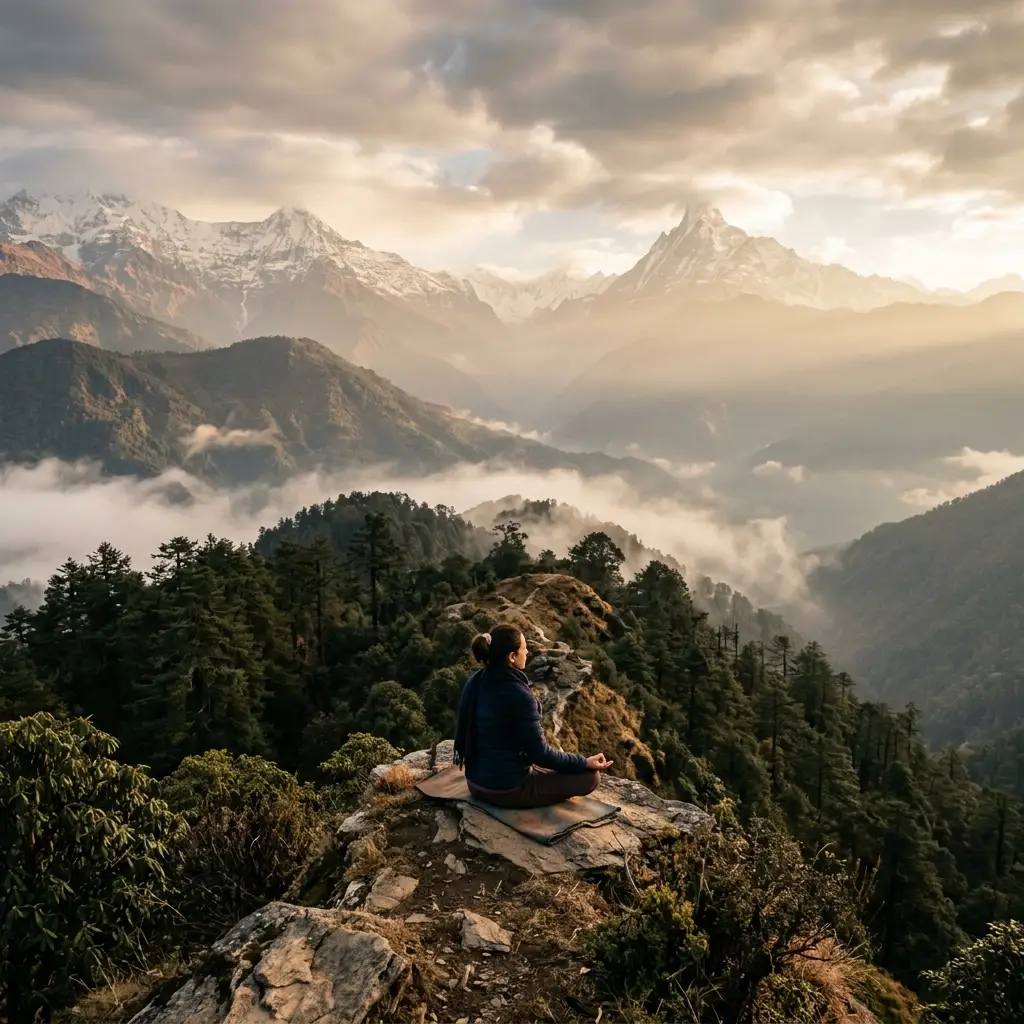
Munsiyari sits at 2,200 metres facing the Panchachuli peaks — five summits rising above 6,000 metres. The meditation experience here is defined by spaciousness: open sky, vast mountain views, and the kind of silence that comes from being far above the treeline with very few other humans in sight.
5. Sankri — Trek & Meditation Integration
Sankri is a remote Himalayan basecamp — the launching point for Kedarkantha, Har Ki Dun, and other classic treks. Meditation here is not separate from movement; it is integrated with it. Walk through forests of oak and rhododendron, sit at camp, and let the body's exertion become the preparation for stillness.
Himalayan Retreats vs. Coastal & Ashram Settings
Himalayan Mountain
Use altitude, remoteness, and natural silence as active elements. At 2,000–3,500 metres, reduced oxygen gently quiets mental chatter. Dense forests absorb ambient sound. The absence of phone signal removes habitual triggers. The land does half the work.
Coastal Retreats
Goa, Kerala, parts of Karnataka — offer warmth, comfort, and accessibility. However, they are at sea level (no altitude benefit), near tourist infrastructure (more noise), and in tropical heat (can make long sitting uncomfortable). Better for yoga breaks than deep silence.
Ashram Retreats
Rishikesh, Varanasi, South India — offer spiritual lineage and community. Embedded in living traditions: daily rituals, chanting, teacher-student relationships extending back centuries. For philosophical grounding alongside technique, ashrams offer something mountains alone cannot.
Our network includes both Himalayan mountain settings (Zanskar, Chakrata, Munsiyari, Sankri) and ashram-influenced practice (Rishikesh), giving you access to both paradigms. See our guide to choosing a meditation retreat for a structured decision framework.
Meditation Styles at Indian Retreats
Vipassana
Insight meditation using systematic body scanning. Sessions are long (one hour or more), in complete silence, with minimal teacher interaction. Demands discipline and rewards persistence. Available across India, but Himalayan environment — particularly Zanskar — amplifies its effect.
Guided Mindfulness
Uses verbal instruction to direct attention — to the breath, body sensations, sounds, or thoughts. Most accessible for beginners. Forms the foundation of our 3-day retreats. Reduces the anxiety of "not knowing what to do."
Yogic Meditation (Dhyana)
Follows the Patanjali tradition, integrated with physical yoga practice. Pranayama (breathwork) and asana prepare the body; meditation follows as the natural extension. Particularly strong in Rishikesh, where the yoga tradition provides both technique and philosophical framework.
Walking & Movement
Integrates awareness practice with physical movement — forest walks, mountain traverses, or structured kinhin. Central to our trek-and-meditate programmes. Ideal for people who find extended sitting uncomfortable.
How Long Should a Meditation Retreat Be?
3 Days
Enough to break the rhythm of daily life and experience a genuine shift in mental pace. First day is decompression; second day is where silence begins to work; third day consolidates. Ideal for first-timers, busy professionals, or testing whether extended practice is right for you.
Explore 3-day retreat →5–7 Days
The minimum duration for real depth. By day three or four, the habitual mind runs out of familiar narratives and begins to settle. Five to seven days allows time for the nervous system to downregulate, for sleep to deepen, and for insight to arise naturally.
Explore 7-day retreat →10+ Days
Traditional duration for Vipassana and deep silent retreats. Provides enough time for practice to work through layers of resistance, distraction, and emotional processing. Most participants describe a qualitative shift around day six or seven.
Explore 10-day retreat →If you are unsure about duration, start shorter. A powerful 3-day experience in Chakrata often leads to a 7-day return visit — and eventually to Zanskar. The journey builds on itself.
How to Choose the Right Meditation Retreat
The "best" meditation retreat depends on three factors:
- Experience level: beginners start at Chakrata or Rishikesh; experienced practitioners choose Zanskar or Munsiyari.
- Desired depth: for a reset, 3 days in Chakrata. For transformation, 7+ days in Zanskar.
- Relationship with movement: if you need body and mind together, Sankri integrates trekking with meditation.
See our meditation retreats overview for detailed descriptions of each format, or explore all Himalayan locations in our network.
7-Day Meditation Retreat in Zanskar Valley
Monastery immersion at 3,500 metres. The deepest silent retreat in India — for those ready for radical separation from the ordinary.
Frequently Asked Questions
What is the best meditation retreat in India for beginners?
Chakrata is the best starting point for beginners. At 2,000 metres in a dense Himalayan forest, it provides natural silence without extreme conditions. Sessions are guided, groups are small (maximum 12), and the location is accessible from Dehradun — no flights or difficult mountain roads required. Rishikesh is also excellent for beginners who prefer a more structured, ashram-style environment.
Which is deeper — Zanskar or Rishikesh for meditation?
Zanskar offers deeper immersion for experienced practitioners. At 3,500 metres with century-old monasteries and no phone signal, the environment itself strips away distraction. Rishikesh offers depth through lineage — living ashram traditions, experienced teachers, and the energy of the Ganges. Choose Zanskar for radical separation from the world. Choose Rishikesh for spiritual tradition with more infrastructure.
How long should a meditation retreat be?
Three days is a meaningful reset — enough to taste genuine silence. Five to seven days allows your mind to settle beneath habitual patterns and experience real depth. Ten days or more is standard for Vipassana-style silent retreats. For Zanskar, we recommend a minimum of seven days because two days are spent in transit — the remoteness is the medicine, but it requires commitment.
Do I need meditation experience before attending?
No prior experience is required for our Chakrata and Rishikesh retreats. Guided instruction covers foundational techniques. For Zanskar retreats, some prior meditation experience is recommended — the altitude and remoteness amplify everything, and having a basic practice helps you meet those conditions skillfully.
What makes Himalayan meditation retreats different from Goa or Kerala?
The Himalayas offer altitude, silence, and remoteness that coastal retreat centres cannot replicate. At elevation, reduced oxygen naturally slows the thinking mind. Mountain forests and valleys absorb sonic distraction. The distance from civilisation removes habitual cues. Goa and Kerala are warm, comfortable, and more accessible — but they are also busier, flatter, and closer to tourism infrastructure. If your meditation needs environmental support, the Himalayas are categorically more effective.
Can I combine a meditation retreat with trekking?
Yes — and this combination is particularly effective. Walking in mountains becomes a form of moving meditation. In Zanskar, treks pass through river gorges and ancient monasteries. In Chakrata, forest walks are part of the program. In Sankri, multi-day treks can be combined with base-camp meditation sessions. The body and the mind work together when the land demands it.